Part of the EMT class I'm attending is having actual patient contact. Normally there are two ways of going about this, either time on an ambulance or in a hospital Emergency Department, so last night I spent 8 hours at the Skagit Valley Hospital. I can say, I was anxious but not nervous, I knew that if anything happened and I ended up in over my head, someone would get me out of the way or show me what to do. The anxiety stems from now dealing with real patients, people with real injuries and illnesses, not simulated scenarios, and they are complete strangers. When you're in the hospital with a family member, you are focused in on just what is in front of you, and generally speaking, there isn't much you can do but sit, wait, and listen. Now, I was putting on gloves and following nurses, doctors, and technicians around to provide real patient care. Upon arrival, we met Gene, the charge nurse. Gene was an old Navy vet who has been an RN for I don't know how long, but that department was unequivocally his during that shift. He was like a conductor of a symphony, directing doctors and other staff to where they needed to be, and also being there whenever there was any questions.
We also met Todd, the technician on shift that night. He's an EMT and fire fighter who is continuing his education while working shifts at the hospital. He gave us the grand tour, showing us all the various gadgets and gizmos (good proper medically terminology, eh?) and what to do when and where. After that they divided us up amongst different RN's since we had four students on shift from two different locations, which was unexpected. It was also a slow night, which is great for the general public, but not for students. We started shadowing our RN's around, mine was Alana, who started out down in Phoenix back in 2005. She also worked at another hospital to the south in Arlington, Wa., so she works several shifts each week.
Even though there were no traumas or major codes, it was still an amazing night for learning and putting "soft skills" to use. I was able to sit in on several procedures, help with vitals, move patients and just be supportive for them. The nurses all appreciated the extra hands, since we could run and grab certain items or help move or hold people if they needed us. Alana also went over charting and documentation with me, which is of the utmost importance in the medical field. They teach this at all levels of healthcare, "If it isn't written down, it didn't happen".
As the night wound down, my partner and I were experiencing fatigue, but we kept going until 7am. We both walked out with smiles on our faces, even if we could barely see straight. I may not have been able to dispense much in the way of hands on care, but I was able to dispense comfort and encouragement, and receive the same from many of the patients. I had a gentleman tell me it was a great thing to be doing what I wanted to do with my life before it was too late, and was thanked by his sister for being there to help care for him. My partner and I were thanked by another gentleman's wife for being there and helping care for him as well. It felt good, even though I'm not going into this field for praise and recognition, but to see that you may have made a little difference when one someone was having a really bad day......That was an amazing experience.
Saturday, February 4, 2012

Sunday, January 29, 2012
Snow, and the Zen of Hiking
This is an incomplete essay I'm working on, but I thought I'd share my progress thus far.
Snow, And the Zen of Hiking
By Jeff Pierce
Snow is one of the environments great universal equalizers. It doesn’t care how tough you are (mentally or physically), or how well prepared you think you are, snow will win. This was the thought that came to me while hiking today, what I felt at first was a failed attempt at reaching my Zen state, that after a few rationalizing minutes I realized was a minor moment of clarity. Think about that for a second. We’ve all been there at some point, the snowball to the face, the car in the ditch, or even worse. Do you think the Donner Party thought this out while they were starving? More MEN died in the Donner party than women. This then stirred up the internal struggle debate, my little duality issues. I love snow, even though it has tried to kill me on more than one occasion. How many people can rationalize something like that? You love something that would just as soon destroy you as make your environment into your favorite playground. Ahh, love hate relationships.
I try to use hiking as a way to reconnect not only with nature, but with myself, the never ending swirls of disconnected thoughts inside my head. As I’ve said before, on my journeys outbound, I can approach a Zen state, not letting the disconnected thoughts win, but clearing my mind isn’t Zen. It is peaceful, don’t get me wrong, but Zen by definition is “direct self-realization through meditation”. Am I self-realizing when there are no thoughts to be had? But then there is the pause, the trails end, the return home when the introspection begins. The thoughts begin to flood back, and today it was thinking of the times in my life when snow won, or came very close. Snow has made me realize or understand my mortality on a few occasions, as anyone who reads any of my rambling knows.
Can it be this simple? While wandering around in the forest to reach some sort of enlightenment? Ok, so I’ve not achieved self-enlightenment in the Buddhist sense of the meaning, but I keep having those “Aha!” moments more often. I personally feel the key is to follow those “Aha!” moments instead of pondering them whimsically and then filing them away in the grey matter. That moment is usually a break through, whether it is personal or universally profound, a breakthrough none the less. Where would we be if Archimedes hadn’t bathed? Personal “Aha!” moments are easier to ignore, we don’t see the significance of the moment to our overall state of mind or well-being. I’ve begun to pay attention to those moments later in life, and they haven’t steered me wrong…….well, so far.
Carl Jung wrote “All consciousness separates, but in dreams we put on the likeness of that more universal, truer, more eternal man dwelling in the darkness of primordial night”. Was he trying to say truer to ourselves? Did he mean truer to the “ideal” or “perception” of what and how a man is supposed to be and act? Society as a whole is a complex structure, and the ideas and perceptions of the society end up shaping those in it. Whether or not they are realistic ideas and perceptions is the issue at hand. We spend our lives being told how to act, how to look, even if we believe that we have a concept of self, but in reality most of what makes “us” is what is fed to us by “them”; the “them” being our peers, our family, the media, or our religion if we have one. Do we really have our own sense of self and identity if what makes us “us” is what we are fed by everyone else…….forcibly at times?
Sometimes the “Aha!” moment is terrifying if it goes against the identity given to us by society. We were programmed to think a certain way, and now all of a sudden this thought comes screaming from out of nowhere. You might think, I wasn’t raised to believe this by my family, my church. You might think that friends will look at you differently now that you have started to become self-aware. Self-awareness can be scary.
Understanding mortality can be even more frightening and lead to a heightened state of self-awareness. That’s a point I can attest to first hand. Having faced my mortality more than once at the beginning of my teens pre-empted me from having to wait through any of societies “manhood” rituals. I didn’t have to jump from a tower with nothing but vines attached to my legs. I didn’t have to climb to an eagles nest high on a cliff to snatch a baby eagle that would then be my companion and hunting partner for the duration of our existences. I was thrust into a different state of mind by almost dying, one that changed my view of society as a whole. I recently read a book by Karl Marlantes titled “What It Is Like To Go To War” which made me ponder my manhood ritual of near death experience, and how it changed several of my decisions later in life. He wrote that most young men (late teens to early twenties) have never had to ponder their mortality by that point, so when they experience combat, it takes everything they’ve been fed by society and throws it right out the window. They now can see that they may not get the chance to have the house, car, and 2.4 children that society has told them they need. Anyone ever wonder why the divorce rate is so high in returning combat vets? While they are gone, the world they knew at home is in a state of constant flux, relationships and events are constantly changing that they have no control over. In the current times, the problems these young men, and women face in combat are then exacerbated by the fact that with modern technologies, they can talk to home with much less difficulty. A friend whose husband was in Iraq a few years ago was able to chat via Skype almost nightly with him.
I almost joined the Army while I was in college, but ended up talking myself out of it. Why you might ask? Here comes that pesky duality again. First off, having faced my own mortality by this point, I knew that if I joined the military, there was a possibility of dying. Flipside of that coin, I may have to take someone else’s life. Because I valued my own life having almost lost it at a young age, I couldn’t see myself taking another young man’s life because of reasons I may not believe in. Don’t get me wrong, I’m not a pacifist who doesn’t think we should fight. I do agree with fighting for what I believe in, and war as a concept will never go away. It is human nature for societies to engage each other with violent conflict for reasons known or unknown. Tyrants invade, dictator’s rule, neighboring tribes occupy better lands than other tribes. Conflict is almost instinct in humans, the “I want what you have”. If taking what another society has is a tool for the invading society’s survival is one thing, but humans are territorial and constantly trying to keep up with the Joneses.
You might be thinking, “I’ve never been to war or in a major conflict for what I possess”, but you may be mistaken. In everyday life, people are in conflict with another person to attain what they feel they need. You may be in conflict with your boss for more hours or pay; you might be in conflict with you bank, your bills, or the bill collectors. After all, if they take all your money, you can’t get all that society says you need. You may not need a bigger house, better car, or have more children, but that is what society is telling you. Your society; friends, family, media, advertising, they are all bombarding you constantly to upsize, upgrade and consume. Why do you think that they refer to customers as consumers? That is what we do! We consume, conquer, and control. We’ve lost the ability to understand that there are things beyond our control in the modern day and age. When a child gets sick, we just assume that modern medicine will have the answer. When there is a car accident, we assume that the surgeon will put Humpty Dumpty back together. We aren’t afraid of what goes bump in the night because we have a false sense of security in which we are lulled into complacency. It has affected our ability to effectively handle traumatic events when they don’t have the positive outcome we’ve grown accustomed to. In ancient times and with aboriginal cultures, death was accepted differently. Warrior cultures felt it was a glorious ending to die in battle or to the service of their gods. Gods, the ancient people’s way of explaining the unexplainable. One of my all-time favorite quotes comes from Howard Phillips Lovecraft who wrote “The oldest and strongest emotion of mankind is fear, and the oldest and strongest kind of fear is the fear of the unknown”.
When ancient cultures couldn’t explain an event or occurrences, they attributed it to gods, those things with no form that mortal man would never see. We have no gods now. We think we’ve seen anything and everything there is to see, or at the very least we can read a blog about it or look it up on Wikipedia. This makes surprise all the more shocking. We need to be in awe of the natural world again, but we’ve been over-stimulated by information overload. A society that is numb is doomed to failure, maybe not now but eventually. What I keep seeing is people numbed to anything perceived as bad, and stimulated by the trivial. Again I ask a question, why do you think that “Reality TV” is so popular? Is it because the general population’s menial lives are so boring that they must live vicariously through “Survivor” or “Dancing With The Stars”? Go on a hike or take some dance lessons! Live for yourself, not through others on television. Again it is society telling you how to be and act. They want you lazy and complacent so they can sell you the next great fitness trend or a video game so you can pretend you are dancing……in front of your own damn TV! Societies used to offer praise and thanks to what they felt sustained them, now we worship money, status, and possessions.
These are the thoughts I have while hiking through the forest. This is how I go from “snow” to “consumerism”. It’s all a process of taking the disconnected thoughts in my head and sorting them out to make some semblance of rationality. In the end, what I find is that my thinking keeps getting further away from what society tells us how we should think and act to fit it. These thoughts aren’t new; I’ve had them for years but acted on them in a different manner, a more destructive way of thinking and acting. It was rebelling against a perceived authority, which in reality the authority was just society in general. I didn’t want to think the same way as everyone else or try and be fashionable and “fit in”. I wanted everyone else to open their eyes and see what I did. I wanted everyone else to feel the sense of doom I felt for society. When we see a genocide or famine on the news, Western society especially cannot fathom an event so horrific happening in a civilized society. What they don’t see or can’t comprehend is these events could happen anywhere and to anyone, but also that they are contributing to these atrocities by being the “haves” to the “have nots”. You might think this is a stretch, but would you be willing to give up your comforts so that another person may gain the bare essential to simply survive? You may be thinking to yourself, “I donated to a charity”, but how many times? If you did it once to make yourself feel good or better than everyone else, then that is a shame on you.
Humans have to do things to make themselves feel better about life or to achieve a sense of superiority over others. Simply stated, it is wanting to feel “holier than thou”; I don’t think there really is a better way of summing that up. “Yeah, I donated to XYZ charity because they are helping poor orphans in –pick your war-torn country. Oh, you don’t donate to charities, shame”. But then you donate only once and now those orphans who could have received clean water, possibly an education, and the chance to live past age 5 are dying off in record numbers from Cholera or famine. Go ahead perform charitable acts to feel more superior to others, just do them more than once. Or, do us a favor and save your money. You’re going to need it when you lose your job and your house is in foreclosure. Those who have can never seem to make any real sacrifices for the benefit of others, but will sure scream foul once they are in dire straits and need some assistance. If one day you woke up and realized that you were going into foreclosure, couldn’t make your car payments, and would have to stop paying tuition for your 2.4 children, you would want a little help to. There again, society is lulled into a false sense of security. We are made to think that there is assistance for us, that our churches, governments, even neighbors will bail us out. Ho, ho! Wrong way of thinking, my friends. The money will run out, the neighbors that you’ve never had over to your house for a barbeque will shun you, and when the cumulative effects drain the coffers from all available resources, you’ll begin to wish that maybe people could be a little more kind and generous.
Hunter S. Thompson liked to use the term hubris in his writing as a way to describe his or others actions just before they failed fantastically. The literal definition of hubris is “excessive pride toward or defiance of the gods, leading to nemesis”. We have become an over bloated and defiant consumerist society, and the gods, those things we can’t explain, are going to humble us eventually. Modern society is edging ever closer to a tipping point, where the needs of the citizens are going to overwhelm the resources available. If people forget self-reliance and can’t learn to revert back to the origins of true society, humanity is doomed. We’ve gotten cocky, but we are just a blip on the cosmic timeline. For all we know, we were a genetic evolutionary mistake, and just as other species have come and gone before us and during our time here, we one day will also be a memory. In the evolutionary scheme of things, we’re an eye blink, a fraction of an epoch. Just my observations in the 37 years I’ve existed in this organization of atoms, and what I feel for me is the right path, is to regain a sense of community. We as a species have lost that aspect of our lives to social networking and reality television. How many people actually wave at each other anymore, or just random strangers for that matter? One thing I’ve always enjoyed is driving up to visit my parents, the sense of community that still exists in some of the more rural parts of our country. Random people are always waving, always smiling. Everyone seems to have a feeling of contentment; people care about their neighbors and come together when tragedies or other events happen. Community and society shouldn’t define us, they should help us to feel complete. Remember the old adage that it takes a village to raise a child? Everyone had a place and was fundamentally essential for the survival of others. That direct interaction makes people stronger, both physically and mentally, and for humanity to survive, we need to be that global community instead of a global society.
Does this mean that I reject the notion of a house, car and 2.4 children? Not necessarily, but my internal struggle is in how I want to come about having these things. I have a car, it does its job and isn’t anything flashy or fancy. I live in an apartment, but whether I’m living in a house, tent, cabin, or a lean-to shelter, I am happy with a roof over my head. I once spent a winter in Northern California living in an old camper parked inside a warehouse. It was warm enough, dry enough, and secure enough. I was content. The roof over your head doesn’t need to be anything fantastic and extravagant, but modern culture has become accustomed to a certain level of comfort. Is this level of comfort absolutely necessary for survival? No, not really, but once you have attained that level of comfort, you don’t feel the desire to relinquish it without a fight. Maybe this is why I’ve always enjoyed Fight Club so much (I need to read the book, I feel like a schmuck for only watching the movie hundreds of times). The concept of either losing all to gain your identity, or rejecting the media imposed ideal of what a person should look like and act like. “Once you’ve lost everything you are free to do anything”. Oh, how wonderful it would be to shed all of your societal constraints and just be yourself for a change!
Can we, as a community, shed the societal constraints of normality and just be ourselves? I often wonder what kind of parent I would make, and if in this modern day and age I would even want to bring a child into this world. I’ve met many people who say that at first the concept of becoming a parent is frightening; they think up all the ways possible that things can go wrong. What ever happened to nature taking its course? In early cultures, becoming a parent was for the benefit of the community, and as cold as this may sound, a child dying at birth was usually a matter of natural selection. Would they have had the strength to grow to adulthood and provide for the community? In that early community, everyone had an essential function, from hunting and gathering, to making clothing and shelter. If the weak survived, then what affect would that have had on the strength of the community as a whole? The community would become weakened by not having an essential set of hands, another able mind and body. I bet you’re all thinking to yourselves, how could I sound so indifferent to the life of a child? Well, I’ll pose this question, how many parents in the modern era would have an abortion if they found out their unborn child had a major medical “defect”, one that would not only affect the life child’s potential, but would limit the parents financially, socially, or the proclivity for leisure time?
In this modernized, mechanized, industrialized society we live in, parents can make the selection before the child is born, but then even if the birth is “normal”, who’s to say that child will survive to a ripe old age, and if they will ever be a productive member of that society. I think I can safely say that if a mega-catastrophe was to engulf the continent we live on, most people would perish simply because they had no creative thinking skills, no basic survival skills, and certainly not the strong interpersonal relationships and communication required to lead and organize. It is this dumbing-down of the next generations that will do us in, unless parents can learn to instill in their children true survival skills. Sure, knowing how to fix the car, hook up the TV, and look both ways before crossing the street are good things to know, but they are not essential for survival. Knowing how to tweet isn’t going to save your life. I’m sure that you’ll be one of the first to know that the disaster has happened, but once you lose power and can’t play your X-Box anymore, you are effectively screwed. We’ve also grown accustomed to the event of a child dying being a downright tragedy. Yes, losing a child is difficult and life altering, but it shouldn’t come as a surprise. Parents should celebrate the birth, that first hurdle, then try to pass on all the love and knowledge they can before time runs out, which we all know is going to happen, but no one wants to face their own mortality. You are going to die, get over it. What you do in the meantime is what defines you. Are you going to be the guy that no one attends your funeral, or are you going to be celebrated for all the lives you touched on your journey to the inevitable. Two significant examples that I draw encouragement from are my grandfather and one of my cousins who have passed on since I’ve reached adulthood. My grandfather taught me much through my life, and community was an important lesson. You needed to help your neighbor, be a helping hand, and defend those who couldn’t defend themselves. When my grandfather passed, we packed a high school gym to standing room only, this man who some would have looked at as just an old retired logger. It was the lives of others he affected on his journey that truly defined him as a man. My cousin Ron died very suddenly a little over a year ago, and although we hadn’t been as close as I would have liked over the previous few year (busy with this or that, we all make excuses until it’s too late), it was still a harsh blow to the family. I hadn’t cried when I received the phone call, not even when I drove up to Washington to my parents place the day before the funeral. I talked to my folks about how his family was doing, and the what-where-when of the funeral service. They held it at the Klickitat County Rodeo Grounds, since that had always been Ron’s passion, as well as one of his favorite places. It didn’t hit me until I looked at the crowd in the grandstands, and then out to the road leading in where a line of cars as far as the eye could see where still arriving to pay their respects to this humble logger, farmer, husband, and father. I absolutely lost it. A flood of emotion poured over me, this is community, this is family, this is what constitutes the most important part of our lives. Not what we have, not our status in society, but how “your” community remembers you.
There is a wonderful oral tradition in many Native American cultures, as well as stories in art from pottery, totems, lodges, even the blankets they weave which are essential to their own survival. The stories tell of their lineage, their ancestors, those who carried traditions forward and the great leaders of men. Now in modern times, we gauge someone off their twitter followers or how many people are on their friends list. We have no great community leaders anymore, it’s all a popularity contest and a race to amass as many possessions as possible before we die. Status in a “clan” used to be more based on character, leadership, and how well you could survive, let alone how well you could keep others sustained. If you were a good hunter and provided for the rest of the tribe, clan, whatever kind of group, you held status. You showed that you cared for the others and recognized that they were essential to your own survival. People don’t understand interdependency like they used to. We are all interdependent, but not in such a direct manner. My neighbors’ personal health and well-being doesn’t directly affect my life or livelihood. But should I be concerned for that neighbor? Absolutely! This is the idea that has become lost the more electronically connected we’ve become. Now we don’t have to wait weeks or months to communicate, we chat online with friends or send text messages halfway around the world, but then fail to connect directly with those around us.
I started to become guilty of the e-living ideology. I could talk to people I’d never met in person who lived nowhere near me, we could form our own “community”, and live in a world beyond physical interaction. It doesn’t take long before those types of societies begin to break down. If there is no clearly defined hierarchy, then conflict ensues, and people decide to “take their ball and go home”. You are trying to establish a community with maybe one common interest, but the personalities are so diverse, there’s no way that conflict can be avoided, especially with the anonymity of the internet and the personalities people develop. I hear so often from people, “He’s really a nice guy in real life, but sometimes acts like a jerk on the computer”. This shield, our computer screen that gives us a measure of protection begins to define us further. People become addicted to their web-based lives and can’t step away and see what lies in front of them: reality. We are losing our sense of self identity, at least what little of it is truly our own every time we tweet, update facebook, argue on a forum, or become totally engrossed in internet drama. Information is just a few mouse clicks away, so we are lulled into a false sense of security thinking we will always have access. It will all come down some day, and if you can’t find a book to reference, you are left strictly with what is in your head. We should all become life-long learners, or learn to regain a sense of community. If you don’t know everything, there’s a fair chance someone around you does. You come together with this knowledge base, and solve problems as a team. You share information and ideas for the benefit of the community, and then pass them on when the time comes.
Monday, January 2, 2012
January 2nd.......
Re-posting another older story of mine and how January 2nd is a date with significant meaning to me. The meaning has changed over the years....... In fact a few years ago or so, I totally forgot about it until near the end of the day, which to me signified that I no longer looked upon this day with dread. Since then, January 2nd had shifted to mean new beginnings but remembering why I'm currently doing what I'm doing. I've always wanted to become an EMT to give back something because of the selfless people who saved my sister and I. So, here it is........
Most people can travel through a fair majority of their lives without a single near death experience. It's a thought that lingers in most peoples minds, and it can either inhibit their actions by occupying their thoughts, or never occur to them for most of their lives. Or you can be like me, and come close to dying twice before even turning 14. It can be a sobering experience, and shape your outlook on life drastically.
The first near death experience happened when I was 12. Christmas break was coming to a close, and it was time to head back to school. I started to become ill, and thinking it was just the flu, my mom had me stay home rather than going to school that week. My dad was out of town at a training session, and my mom was working full time, so I spent my days home alone. The first few were just miserable, as anyone who has had the flu knows, but then it became worse. Thankfully my friend Jerry's mom was at home, and they lived right next door. I called Martha when I became violently nauseous, I couldn't even seem to keep water down. She came and checked on me, and tried to do her best to help. My head felt as if someone had parked a truck on it, the absolute worst headache I'd ever had. Even she became concerned, thinking that it might be more than just the flu. She called my mom at work, to let her know, and they agreed that if I wasn't doing better by the time my mom was off work, then we would head to the hospital.
Now, nausea by it self is never fun, but I could take Tylenol with water, and not even hold it for 5 minutes. It was if my body was rejecting everything I tried to eat or drink. And the headache became worse, which I didn't think was possible. The only way to describe it was that someone was crushing my skull. At this point, I was starting to feel rather panicked. Mom came home, and immediately loaded me into the car to head to the hospital. I was in a daze, no way to focus, even sound caused extreme pain...... And it was an hour drive on ice covered roads to get to the closest hospital. Skyline Hospital in White Salmon, Wa. Is a small hospital, with only a few doctors on staff, including our family physician. My mom had called ahead of time, so he was waiting for our arrival. Instantly he suspected meningitis, which I'd never even heard of before, but by my moms reaction, I could tell it wasn't good. Then came the Lumbar Puncture. I could say that an LP is one of the most painful procedures you could go through while conscious, but then and there, I was only thankful it took my mind off of the pain in my head!
I was immediately admitted, and hooked up to several IV's and given powerful pain killers...... and simply slept. I slept for a good 18 hours, the first real sleep I'd had in several days. After a few days, I learned the gravity of the situation. Our doctor told my mom that if she'd waited even a few more hours I could have died. That's quite a thing for a 12 year old kid to fathom. I stayed in the hospital for almost a week before I was allowed to go home, and return to school. My classmates were fairly freaked out to learn I had been close to death, as the last they'd heard was I had the flu. I worked my way back into a normal routine, and over the course of the year, tried to forget about having a near death experience. Unfortunately almost exactly a year later, it would happen again.
The rest of 1987 was uneventful, I can't even really recall much that happened that year, until just before Christmas. My sister Amy was a senior in high school, and had been spending a fair amount of time in Portland. My sister has always loved cities, so any chance she had to go to Portland she took. Her friend Stephanie, who was a year older, had been living there for a few months for college, so Amy would spend weekends with her. While hanging out in Portland, she had met a guy named Rolo, his street name, I can't even recall his real name. He was an "artist" of sorts, selling his leather crafts on the Portland streets. To her he was charming and intelligent, and after a short time they started dating. Right before Christmas, she spent a few days with Stephanie, and we invited Rolo to come back and spend Christmas with us, since he had no family to see, at least none we knew of. As an impressionable 13 year old, I thought that Rolo was a cool guy, he'd spend hours talking with me about life in Portland and his philosophies of life in general. We had no clue of what lay beneath the surface of his personality.
After Christmas, we drove Amy and Rolo back to Portland, where she was going to stay a few more days over New Years before having to go back to school. The day after New Years, we planned on driving up to Trout Lake and Glenwood to see grandparents and other family. My Grandma (dads mom) lived in Glenwood, and my Grandpa (my moms dad) lived in Trout Lake, only about 20 minutes apart, so it was easy to visit both sides of the family in one day. Then on the evening of the 1st, we got the call from Amy. Rolo, as it turns out, was bi-polar, and had gone into a violent rage that night. I don't know if he ever abused Amy, but it was enough to scare her to the point that she wanted us to come and pick her up as soon as possible. Dad decided we'd drive into Portland early in the morning on the 2nd, a Saturday, then make the trek back down the Gorge and up to Trout Lake and Glenwood. If Rolo hadn't gone into his rage, my sister would have never been with us, and the days outcome could have been much different.
We drove up to Glenwood first. Several trees had fallen in a windstorm, so my dad was going to cut firewood, since the weather was holding fairly decent. We spent several hours with Grandma, then my mom, Amy and I all loaded up and drove to Trout Lake to see Gramps and other family. The roads weren't in the best shape, plowed but not sanded, but decent enough that we had no problems driving over. I ended up spending most of the day running around in the snow with my cousin Derek, who is the same age as Amy, wasting gas and screwing around. As it was getting dark, we came back to Gramps house, and it was time to head back over to Glenwood to have dinner. It had been a long day, so shortly after we left, I fell asleep in the front seat of the rig. We had an Old BroncoII, and in four wheel drive, it handled most of the snowy roads well. Amy was sitting in the back, right behind me, listening to music.
Not even halfway back, I awoke suddenly to my mom and Amy screaming......... What the?!?....All I remember is seeing trees, the sound of metal scraping against rock, and the sensation of the Bronco rolling over. When I regained consciousness, I was hanging upside down, not knowing what had just happened. I also didn't realize that the top of my scalp had been sliced open, and I was bleeding profusely. I remember my mom screaming for Amy, but not being able to see or reach her. I managed to undo my seatbelt and crawl out the driver side door window. I was in shock, but I could hear the sound of another vehicle coming down the road. My mom raced up the bank, which was no easy climb. Twenty feet of vertical boulders, but I swear she climbed it in two seconds flat. Instinctively I tried to reach for Amy, calling her name, but I couldn't see or hear her. My mom stopped the car that was coming down the road, and I can remember her screaming "I think my daughter is dead!!!". That has stuck with me ever since, the most horrible thing I could ever imagine my mom saying. I had lost so much blood by now, that I was on the verge of passing out. I could hear other vehicles stopping, the sound of car doors and voices. I stood up, looked up at the sky and watched the snowflakes fall in the eerie glow of headlights on the road. I remember feeling my scalp, and thinking to my self that my head was all wet and I should have a hat.....then I passed out in the snow.
I'm not an overly spiritual man, but I do believe in miracles. Within two minutes of the accident, over forty vehicles drove down that remote stretch of road. Turns out, they were from White Salmon, and headed to a basketball game. Even though it was it was a longer drive for them to take the route they chose, it was generally a better road than the shorter route, which wound its way up a steep canyon. In the caravan of travelers, there were several EMT's, including Billy Gross. I credit that man (rest in peace) for saving my life and my sisters life that night. I became conscious again in the front seat of someone's car. I don't recall how I got there, just that I was holding a coat or scarf on my scalp. I awoke when the door opened, and a voice said "We got your sister out, and we're gonna head toward White Salmon and meet the ambulances on the highway, ok?". I nodded, and whomever it was shut the door. Behind me, a small child in a car seat started crying. I remember saying "Its ok kid, everything is gonna be ok"........ And then blackness.
During the next twenty four hours, I can only recall one little snippet of consciousness. I awoke to the feeling of rocking back and forth, and a warm breeze blowing on my face. I opened my eyes, and I could tell I was in an ambulance, then nothing. That was everything I could remember from Saturday the 2nd, until Sunday evening. I woke up in a hospital bed, a male RN checking my blood pressure. He smiled and asked me "Do you know where you are?", to which I replied "Yeah, I'm in a fucking hospital!". I knew right were I was......, well, maybe not which city or which day, but after the prior years experiences, I knew pretty quick what it was to wake up in a hospital bed!
"Your sister is in Intensive Care just down the hall, she was hurt pretty bad too. Your parents are with her, I'll go get them and let them know you are awake". My mom and dad came into the room, tears streaming down their faces. I had a fractured vertebrae so they could only hug me very gently, but it was probably the most joyous hug any of us ever had. My dad couldn't even talk. My dad, the solemn, unemotional, and quiet man was crying like a baby. I'd only ever see my dad cry once before, when I was a child. I thought that nothing could break him down. I guess almost losing both of your children in one instant will do that. The first thing I asked was how Amy was. She'd been hurt much worse than I, suffering two shattered vertebrae and a skull fracture. The amazing fact for both of us was neither of us suffered any spinal cord damage, which shocked the doctors. It wouldn't be the last time we surprised them before it was all over.
Being that Amy and I were both on the Neurological floor at Good Samaritan in Portland, they decided that once Amy could be moved, they would bring her into the same room that I was in. It was the first time in the history of that hospital to have two relatives in the same room. The day they wheeled her bed in, they brought her right next to me, and we just reached out and held each others hand for a minute. She was still pretty out of it, we were both on morphine at the time, but it was still emotional for both of us. We knew right there that we were going to be ok. Friends and family were coming and going non stop. The room was full of flowers and cards, some from friends I hadn't heard from in years. Word spread far and wide, and the outpouring of support was astounding. I made up my mind right then and there I was getting out of this place as soon as I could. I was to be put in a body cast by the end of the week, going from my waistline to my chest. Not a wonderful prospect, but I was told that as soon as it was on, I could start working on walking again. Yeah buddy!! I was so sick and tired of laying in that damn bed, I was ready to get moving again. As soon as the cast was on, I was up and about, toting my IV buddy around up and down the halls of the 4th floor.
The staff was completely shocked, expecting that I would be too weak or tired, or in too much pain. To hell with the pain, I was moving again. I could walk. I wasn't going to spend the rest of my life in a wheelchair. That was all that mattered to me, knowing I'd suffered a broken back, but could still walk, and I was going to walk my way out of there as soon as possible! It ended up being only a few more days before I was released, to the amazement of everyone around me. They said I'd most likely be in the hospital for a month, I was out in a week. Amy had the same determination that I had. She went through several hours of surgery, including bone grafts and steel rods to wire her spine back together. They told her two months, she was out in a little over two weeks.
To the day I die, I will blame Rolo for Amy being with us that day. If he hadn't gone all manic, then she might not have had to suffer through what happened. Then again, it shaped who we are today, and brought our family much closer together. I've had my fair share of close calls over the years since, but nothing even remotely close to either of those experiences. I learned to live my life not fearing death. Not that I'm in any big hurry to get there, but if it was my time, then it was my time. If you spend too much time thinking about dying, then you aren't really living, and I'd rather spend my time living.
Near Death Experience
The first near death experience happened when I was 12. Christmas break was coming to a close, and it was time to head back to school. I started to become ill, and thinking it was just the flu, my mom had me stay home rather than going to school that week. My dad was out of town at a training session, and my mom was working full time, so I spent my days home alone. The first few were just miserable, as anyone who has had the flu knows, but then it became worse. Thankfully my friend Jerry's mom was at home, and they lived right next door. I called Martha when I became violently nauseous, I couldn't even seem to keep water down. She came and checked on me, and tried to do her best to help. My head felt as if someone had parked a truck on it, the absolute worst headache I'd ever had. Even she became concerned, thinking that it might be more than just the flu. She called my mom at work, to let her know, and they agreed that if I wasn't doing better by the time my mom was off work, then we would head to the hospital.
Now, nausea by it self is never fun, but I could take Tylenol with water, and not even hold it for 5 minutes. It was if my body was rejecting everything I tried to eat or drink. And the headache became worse, which I didn't think was possible. The only way to describe it was that someone was crushing my skull. At this point, I was starting to feel rather panicked. Mom came home, and immediately loaded me into the car to head to the hospital. I was in a daze, no way to focus, even sound caused extreme pain...... And it was an hour drive on ice covered roads to get to the closest hospital. Skyline Hospital in White Salmon, Wa. Is a small hospital, with only a few doctors on staff, including our family physician. My mom had called ahead of time, so he was waiting for our arrival. Instantly he suspected meningitis, which I'd never even heard of before, but by my moms reaction, I could tell it wasn't good. Then came the Lumbar Puncture. I could say that an LP is one of the most painful procedures you could go through while conscious, but then and there, I was only thankful it took my mind off of the pain in my head!
I was immediately admitted, and hooked up to several IV's and given powerful pain killers...... and simply slept. I slept for a good 18 hours, the first real sleep I'd had in several days. After a few days, I learned the gravity of the situation. Our doctor told my mom that if she'd waited even a few more hours I could have died. That's quite a thing for a 12 year old kid to fathom. I stayed in the hospital for almost a week before I was allowed to go home, and return to school. My classmates were fairly freaked out to learn I had been close to death, as the last they'd heard was I had the flu. I worked my way back into a normal routine, and over the course of the year, tried to forget about having a near death experience. Unfortunately almost exactly a year later, it would happen again.
The rest of 1987 was uneventful, I can't even really recall much that happened that year, until just before Christmas. My sister Amy was a senior in high school, and had been spending a fair amount of time in Portland. My sister has always loved cities, so any chance she had to go to Portland she took. Her friend Stephanie, who was a year older, had been living there for a few months for college, so Amy would spend weekends with her. While hanging out in Portland, she had met a guy named Rolo, his street name, I can't even recall his real name. He was an "artist" of sorts, selling his leather crafts on the Portland streets. To her he was charming and intelligent, and after a short time they started dating. Right before Christmas, she spent a few days with Stephanie, and we invited Rolo to come back and spend Christmas with us, since he had no family to see, at least none we knew of. As an impressionable 13 year old, I thought that Rolo was a cool guy, he'd spend hours talking with me about life in Portland and his philosophies of life in general. We had no clue of what lay beneath the surface of his personality.
After Christmas, we drove Amy and Rolo back to Portland, where she was going to stay a few more days over New Years before having to go back to school. The day after New Years, we planned on driving up to Trout Lake and Glenwood to see grandparents and other family. My Grandma (dads mom) lived in Glenwood, and my Grandpa (my moms dad) lived in Trout Lake, only about 20 minutes apart, so it was easy to visit both sides of the family in one day. Then on the evening of the 1st, we got the call from Amy. Rolo, as it turns out, was bi-polar, and had gone into a violent rage that night. I don't know if he ever abused Amy, but it was enough to scare her to the point that she wanted us to come and pick her up as soon as possible. Dad decided we'd drive into Portland early in the morning on the 2nd, a Saturday, then make the trek back down the Gorge and up to Trout Lake and Glenwood. If Rolo hadn't gone into his rage, my sister would have never been with us, and the days outcome could have been much different.
We drove up to Glenwood first. Several trees had fallen in a windstorm, so my dad was going to cut firewood, since the weather was holding fairly decent. We spent several hours with Grandma, then my mom, Amy and I all loaded up and drove to Trout Lake to see Gramps and other family. The roads weren't in the best shape, plowed but not sanded, but decent enough that we had no problems driving over. I ended up spending most of the day running around in the snow with my cousin Derek, who is the same age as Amy, wasting gas and screwing around. As it was getting dark, we came back to Gramps house, and it was time to head back over to Glenwood to have dinner. It had been a long day, so shortly after we left, I fell asleep in the front seat of the rig. We had an Old BroncoII, and in four wheel drive, it handled most of the snowy roads well. Amy was sitting in the back, right behind me, listening to music.
Not even halfway back, I awoke suddenly to my mom and Amy screaming......... What the?!?....All I remember is seeing trees, the sound of metal scraping against rock, and the sensation of the Bronco rolling over. When I regained consciousness, I was hanging upside down, not knowing what had just happened. I also didn't realize that the top of my scalp had been sliced open, and I was bleeding profusely. I remember my mom screaming for Amy, but not being able to see or reach her. I managed to undo my seatbelt and crawl out the driver side door window. I was in shock, but I could hear the sound of another vehicle coming down the road. My mom raced up the bank, which was no easy climb. Twenty feet of vertical boulders, but I swear she climbed it in two seconds flat. Instinctively I tried to reach for Amy, calling her name, but I couldn't see or hear her. My mom stopped the car that was coming down the road, and I can remember her screaming "I think my daughter is dead!!!". That has stuck with me ever since, the most horrible thing I could ever imagine my mom saying. I had lost so much blood by now, that I was on the verge of passing out. I could hear other vehicles stopping, the sound of car doors and voices. I stood up, looked up at the sky and watched the snowflakes fall in the eerie glow of headlights on the road. I remember feeling my scalp, and thinking to my self that my head was all wet and I should have a hat.....then I passed out in the snow.
I'm not an overly spiritual man, but I do believe in miracles. Within two minutes of the accident, over forty vehicles drove down that remote stretch of road. Turns out, they were from White Salmon, and headed to a basketball game. Even though it was it was a longer drive for them to take the route they chose, it was generally a better road than the shorter route, which wound its way up a steep canyon. In the caravan of travelers, there were several EMT's, including Billy Gross. I credit that man (rest in peace) for saving my life and my sisters life that night. I became conscious again in the front seat of someone's car. I don't recall how I got there, just that I was holding a coat or scarf on my scalp. I awoke when the door opened, and a voice said "We got your sister out, and we're gonna head toward White Salmon and meet the ambulances on the highway, ok?". I nodded, and whomever it was shut the door. Behind me, a small child in a car seat started crying. I remember saying "Its ok kid, everything is gonna be ok"........ And then blackness.
During the next twenty four hours, I can only recall one little snippet of consciousness. I awoke to the feeling of rocking back and forth, and a warm breeze blowing on my face. I opened my eyes, and I could tell I was in an ambulance, then nothing. That was everything I could remember from Saturday the 2nd, until Sunday evening. I woke up in a hospital bed, a male RN checking my blood pressure. He smiled and asked me "Do you know where you are?", to which I replied "Yeah, I'm in a fucking hospital!". I knew right were I was......, well, maybe not which city or which day, but after the prior years experiences, I knew pretty quick what it was to wake up in a hospital bed!
"Your sister is in Intensive Care just down the hall, she was hurt pretty bad too. Your parents are with her, I'll go get them and let them know you are awake". My mom and dad came into the room, tears streaming down their faces. I had a fractured vertebrae so they could only hug me very gently, but it was probably the most joyous hug any of us ever had. My dad couldn't even talk. My dad, the solemn, unemotional, and quiet man was crying like a baby. I'd only ever see my dad cry once before, when I was a child. I thought that nothing could break him down. I guess almost losing both of your children in one instant will do that. The first thing I asked was how Amy was. She'd been hurt much worse than I, suffering two shattered vertebrae and a skull fracture. The amazing fact for both of us was neither of us suffered any spinal cord damage, which shocked the doctors. It wouldn't be the last time we surprised them before it was all over.
Being that Amy and I were both on the Neurological floor at Good Samaritan in Portland, they decided that once Amy could be moved, they would bring her into the same room that I was in. It was the first time in the history of that hospital to have two relatives in the same room. The day they wheeled her bed in, they brought her right next to me, and we just reached out and held each others hand for a minute. She was still pretty out of it, we were both on morphine at the time, but it was still emotional for both of us. We knew right there that we were going to be ok. Friends and family were coming and going non stop. The room was full of flowers and cards, some from friends I hadn't heard from in years. Word spread far and wide, and the outpouring of support was astounding. I made up my mind right then and there I was getting out of this place as soon as I could. I was to be put in a body cast by the end of the week, going from my waistline to my chest. Not a wonderful prospect, but I was told that as soon as it was on, I could start working on walking again. Yeah buddy!! I was so sick and tired of laying in that damn bed, I was ready to get moving again. As soon as the cast was on, I was up and about, toting my IV buddy around up and down the halls of the 4th floor.
The staff was completely shocked, expecting that I would be too weak or tired, or in too much pain. To hell with the pain, I was moving again. I could walk. I wasn't going to spend the rest of my life in a wheelchair. That was all that mattered to me, knowing I'd suffered a broken back, but could still walk, and I was going to walk my way out of there as soon as possible! It ended up being only a few more days before I was released, to the amazement of everyone around me. They said I'd most likely be in the hospital for a month, I was out in a week. Amy had the same determination that I had. She went through several hours of surgery, including bone grafts and steel rods to wire her spine back together. They told her two months, she was out in a little over two weeks.
To the day I die, I will blame Rolo for Amy being with us that day. If he hadn't gone all manic, then she might not have had to suffer through what happened. Then again, it shaped who we are today, and brought our family much closer together. I've had my fair share of close calls over the years since, but nothing even remotely close to either of those experiences. I learned to live my life not fearing death. Not that I'm in any big hurry to get there, but if it was my time, then it was my time. If you spend too much time thinking about dying, then you aren't really living, and I'd rather spend my time living.
Tuesday, September 13, 2011
Changes
I never realized how much smoking affected me, mentally as well as physically, until I quit last summer. It was July last year that decided enough was enough and made the commitment to become smoke free after almost 18 years. I'd smoked here and there growing up, the sneaking a smoke from one of the aunts at a family get together, the camping trip with a school friend that smoked, but it wasn't until September of 1992 that I became a regular, pack a day, addicted smoker. September of 1992 was when I moved from Alaska to Washington for college. At the time, I wasn't sure exactly what I wanted to do with my life, but who really does at 18 and fresh out of high school? I never say "hindsight is 20/20", I agree more with "hindsight is a bitch", because of seeing how much time I squandered with having too much freedom and not enough maturity. I was pursuing a degree in Law Enforcement, having come from a small town where police officers where trusted, respected, and more of an all around public safety officer. They were EMT's and firemen, most had some sort of higher education or extensive military backgrounds. When I was 18, they were people that anyone could approach, even if it was just to ask advice. They were our protectors as well as councilors.
Well, it didn't take long living in Vancouver, Washington to have that perception completely shot to hell. I'd only been there a month the first time I was hassled by a VPD sergeant just for walking home from a friends house at midnight, or a few months later when I was hassled by five Clark County Sheriffs deputies for the same thing. It didn't matter to them that I was studying law enforcement at the local community college, they were bored, angry, and liked to be bullies (at least that was my view of their behavior). What I had lost sight of around then was that I'd started working with the EMT's in Alaska during high school, and had an underlying desire to be trained in a field where I could help people. At the same time, I'd lost my respect for the law enforcement community as not being helpful individuals, but rather bullies who didn't care about the people as much as they cared about their arrest quota (don't get me wrong, I did get to know some fine officers with VPD and CCSO, this was just my general impression).
After bailing on college after 5 terms, I ended up back in Alaska, essentially wasting most of my 20's working crap jobs for low wages, mostly because I was comfortable and didn't really care about anything outside of my little microcosm that was "Craig, Ak.". I could already see my smoking affecting my health by this point, but what I didn't see was what it was doing to me mentally. I was learning to maintain a defeatists attitude toward life, convincing myself that there were physical challenges I would never be able to accomplish, and that was just the way it was. I was also losing interest in education, losing interest in exercising my brain, I honestly felt that I was getting dumber as time went on. Then it hit me, it is time to change my attitudes, change my perceptions, time to get off my ass and start living again!!! After I quit smoking, it was as if everything kicked into high gear, physically as well as mentally. Besides the physical endeavors, I started using my brain again, reading several books, looking at going back to school, taking wilderness medicine classes..... It was a complete attitude shift. The more I saw what others had done with their lives, the more I hated myself for wasting so many years of it.
I finally hit a breaking point. I knew I needed to be doing more, but with my current employment and financial situation, it seemed hopeless. Then it all came together, and I can continue my education without having to stress over the big picture. I have such a desire for knowledge these days, you could say a lust for it, that I almost can't sit still waiting for the next event to unfold. I haven't been this excited and ambitious about making such a tremendous life change since I left Alaska for Arizona in 2000 to work on my pilots license. Even then, I don't think I was this anxious! I feel it is because I now have figured out "what I want to be when I grow up", or at least what I want to be doing. My life has always revolved around the outdoors, but I hadn't been able to put all the pieces together until now. I can combine my love of the outdoors with my desire to help others by taking the Remote Medical Wilderness EMT course in January, as well as taking other medical and rescue classes in the meantime. After that, its back to college, and even though I dread the thought of taking Math and English classes again, it's the desire to achieve the "Bigger Picture" that is motivating me to get off my ass and do it! The "Bigger Picture" is a BA/BS in Outdoor Leadership, possibly OSU, possibly, SOU, but either way, I have goals set that are achievable. Is this my mid-life crisis? I hope so, sports cars are expensive, and at least this will benefit more than just me in the long run.
Well, it didn't take long living in Vancouver, Washington to have that perception completely shot to hell. I'd only been there a month the first time I was hassled by a VPD sergeant just for walking home from a friends house at midnight, or a few months later when I was hassled by five Clark County Sheriffs deputies for the same thing. It didn't matter to them that I was studying law enforcement at the local community college, they were bored, angry, and liked to be bullies (at least that was my view of their behavior). What I had lost sight of around then was that I'd started working with the EMT's in Alaska during high school, and had an underlying desire to be trained in a field where I could help people. At the same time, I'd lost my respect for the law enforcement community as not being helpful individuals, but rather bullies who didn't care about the people as much as they cared about their arrest quota (don't get me wrong, I did get to know some fine officers with VPD and CCSO, this was just my general impression).
After bailing on college after 5 terms, I ended up back in Alaska, essentially wasting most of my 20's working crap jobs for low wages, mostly because I was comfortable and didn't really care about anything outside of my little microcosm that was "Craig, Ak.". I could already see my smoking affecting my health by this point, but what I didn't see was what it was doing to me mentally. I was learning to maintain a defeatists attitude toward life, convincing myself that there were physical challenges I would never be able to accomplish, and that was just the way it was. I was also losing interest in education, losing interest in exercising my brain, I honestly felt that I was getting dumber as time went on. Then it hit me, it is time to change my attitudes, change my perceptions, time to get off my ass and start living again!!! After I quit smoking, it was as if everything kicked into high gear, physically as well as mentally. Besides the physical endeavors, I started using my brain again, reading several books, looking at going back to school, taking wilderness medicine classes..... It was a complete attitude shift. The more I saw what others had done with their lives, the more I hated myself for wasting so many years of it.
I finally hit a breaking point. I knew I needed to be doing more, but with my current employment and financial situation, it seemed hopeless. Then it all came together, and I can continue my education without having to stress over the big picture. I have such a desire for knowledge these days, you could say a lust for it, that I almost can't sit still waiting for the next event to unfold. I haven't been this excited and ambitious about making such a tremendous life change since I left Alaska for Arizona in 2000 to work on my pilots license. Even then, I don't think I was this anxious! I feel it is because I now have figured out "what I want to be when I grow up", or at least what I want to be doing. My life has always revolved around the outdoors, but I hadn't been able to put all the pieces together until now. I can combine my love of the outdoors with my desire to help others by taking the Remote Medical Wilderness EMT course in January, as well as taking other medical and rescue classes in the meantime. After that, its back to college, and even though I dread the thought of taking Math and English classes again, it's the desire to achieve the "Bigger Picture" that is motivating me to get off my ass and do it! The "Bigger Picture" is a BA/BS in Outdoor Leadership, possibly OSU, possibly, SOU, but either way, I have goals set that are achievable. Is this my mid-life crisis? I hope so, sports cars are expensive, and at least this will benefit more than just me in the long run.
Monday, August 29, 2011
My Day With The Dirtbags
Recently I'd read an article in a glossy, over priced climbing magazine called "American Dirtbag" by Andrew Bisharat, that posed the question of "What happened to all the true dirtbags?" His point of view was that either that climbing had become fashionable, or maybe that he had become the yuppie climber he used to hate. Either way, I found out this weekend that if you want to find true dirtbags, the crags at Index, Washington is a place to look. Back in June at the RMI WFR class, I became friends with most of the class, and several there were climbers. After the class and the obligatory facebook group was started, we planned on getting together again later this summer. Plans were laid to meet in Washington somewhere, in August toward the end of the month when it looked like most of us would have free time. It all came together this last weekend, I worked some extra hours to get a few more days off, and headed to Seattle on Friday afternoon. Spent Friday night in Seattle, then took off to Index Saturday around noon having no idea who would all show up, or what was in store for me.
About halfway up, one of the guys in the class (Paul) texted me to find out where I was at, and he was about halfway from Seattle, so I at least knew that someone beside myself would be there. After I found the camping area at Index, I dug out my phone numbers and gave Chris a call, since Index was his idea. He was only a few minutes out, so I sent a few texts to people I was pretty sure who would be there and started figuring out where we were going or what we were doing. Chris came rolling up a few minutes later in his decked out mini-van full of climbing gear and Trader Joe's dumpster diving score, and starts looking for his spot to camp. I waited until Paul showed up at the public area, then Chris rejoined us on his bike and we decided to gear up and do some climbing while we waited for more people. There was no climbing really anywhere near my skill level (which is absolute amateur), so I took pics and took notes from Chris since he's a wealth of knowledge and likes to share that knowledge with others. Simple tips on belay technique or hand and foot placement, didn't matter, he was more than happy to share. After he lead climbed a route and Paul took a shot at it, I belayed Chris so he could clean the route. I thought that was cool, even just a few minutes of coaching and here the least experienced guy was belaying for the most experienced.
After we buttoned things up at that pitch, I gave Lisa and Melina a call, since we knew that they were on the way up. They'd just arrived and were making their way up to the crags. Once they made it up to us, we strolled along the trail while Chris pointed out the different named climbs and gave us descriptions of each. Then we reached Godzilla. Godzilla starts out as a 5.7 then transitions into a 5.9, or you can start off with a 5.10b face on what they called the City Park bolt ladder. Chris started his lead off the 5.7, calling back to Lisa and Melina if they wanted him to set the route as fingers or hands for which crack line he would follow. After completing the pitch and getting back on the ground, it was Melina's turn. After a few tips from Chris on clearing the crack at the bottom, she proceeded to stomp all over Godzilla. I can't recall if she had any falls, I don't believe so (she'll have to correct me if I'm wrong), and then it was Paul's turn, since Lisa would be the last one and cleaning. During all of the climbs, the conversation on the ground was fairly comical, and it was a perfect day to just relax and not really give a shit about anything besides the company and the climb. After Paul's shot, Lisa headed up to clean the pitch, and she zipped up the rock like she had glue on her hands, it was impressive to watch, but then again everyone besides Paul and I have been climbing for years already.
It was time to head back to the river and get some dinner and start drinking, which was when Brian and Angela (? I think that was her name, someone will pipe up and tell me if I'm wrong) joined us. Brian is Chris's boss on Rainier, and another hardcore climber. People started combining food and helping prep while Brian and Chris began cooking. It was an incredible feast for all, even if we were eating off of plastic lids or out of old canteen cups (I never leave home without it), and more food than we knew what to do with. Around then Abe showed up. Abe just sort of ended up at Index and became a local climber, sometimes living by the river, or sometimes house sitting for people. He jumped in and grabbed some grub while a few more people showed up, while Paul, Melina, and Lisa built a fire. Paul left shortly after since he had to work in the morning. After saying our goodbyes we all proceeded to get our drink on around the fire, I broke out the Gin and Tonic, and everyone had beer. Dave and Will showed up, a few more guys living out of their rigs, scraping together all their money for gas and gear to find the next climb. They all swapped stories of where they'd climbed, where they wanted to go next. We laughed and joked, talked relationships, talked about a previous experiences and adventures, almost all died laughing when Brian started rubbing Dave's head because he was so wasted and thought he was standing by Angela. It was a great time, and the majority of the people there live it every day.
Most of them took off into town to the house that Abe was at to hang out, and I rolled out my bag and tried to sleep between trains that flew through at 40-60mph on BNSF's main line not 100 yards away. Finally around 7am I rolled out of bed and started packing my gear to head back South and visit friends in Portland before heading home. Since nobody else was around, I just left a note on the van and said I'd catch up with everyone again later. As I rolled through Index, I see Abe strolling down the street, headlamp still around his neck, same clothes he was wearing the night before, pretty much looking like he'd been around the fire. I asked him what the hell he was doing up so early, and he told me everyone crashed out in a yurt down the road and he was headed back to the house to let the dogs out and check on things. We shook hands, and I left Index, covered in dirt and slightly hung over, but with a huge grin on my face. I'd spent a day with some of the most down to earth people I've ever met, those who would give you what ever they had if you needed it, even if it was just their great company.
 Index WFR Reunion Index, Wa.
About halfway up, one of the guys in the class (Paul) texted me to find out where I was at, and he was about halfway from Seattle, so I at least knew that someone beside myself would be there. After I found the camping area at Index, I dug out my phone numbers and gave Chris a call, since Index was his idea. He was only a few minutes out, so I sent a few texts to people I was pretty sure who would be there and started figuring out where we were going or what we were doing. Chris came rolling up a few minutes later in his decked out mini-van full of climbing gear and Trader Joe's dumpster diving score, and starts looking for his spot to camp. I waited until Paul showed up at the public area, then Chris rejoined us on his bike and we decided to gear up and do some climbing while we waited for more people. There was no climbing really anywhere near my skill level (which is absolute amateur), so I took pics and took notes from Chris since he's a wealth of knowledge and likes to share that knowledge with others. Simple tips on belay technique or hand and foot placement, didn't matter, he was more than happy to share. After he lead climbed a route and Paul took a shot at it, I belayed Chris so he could clean the route. I thought that was cool, even just a few minutes of coaching and here the least experienced guy was belaying for the most experienced.
After we buttoned things up at that pitch, I gave Lisa and Melina a call, since we knew that they were on the way up. They'd just arrived and were making their way up to the crags. Once they made it up to us, we strolled along the trail while Chris pointed out the different named climbs and gave us descriptions of each. Then we reached Godzilla. Godzilla starts out as a 5.7 then transitions into a 5.9, or you can start off with a 5.10b face on what they called the City Park bolt ladder. Chris started his lead off the 5.7, calling back to Lisa and Melina if they wanted him to set the route as fingers or hands for which crack line he would follow. After completing the pitch and getting back on the ground, it was Melina's turn. After a few tips from Chris on clearing the crack at the bottom, she proceeded to stomp all over Godzilla. I can't recall if she had any falls, I don't believe so (she'll have to correct me if I'm wrong), and then it was Paul's turn, since Lisa would be the last one and cleaning. During all of the climbs, the conversation on the ground was fairly comical, and it was a perfect day to just relax and not really give a shit about anything besides the company and the climb. After Paul's shot, Lisa headed up to clean the pitch, and she zipped up the rock like she had glue on her hands, it was impressive to watch, but then again everyone besides Paul and I have been climbing for years already.
It was time to head back to the river and get some dinner and start drinking, which was when Brian and Angela (? I think that was her name, someone will pipe up and tell me if I'm wrong) joined us. Brian is Chris's boss on Rainier, and another hardcore climber. People started combining food and helping prep while Brian and Chris began cooking. It was an incredible feast for all, even if we were eating off of plastic lids or out of old canteen cups (I never leave home without it), and more food than we knew what to do with. Around then Abe showed up. Abe just sort of ended up at Index and became a local climber, sometimes living by the river, or sometimes house sitting for people. He jumped in and grabbed some grub while a few more people showed up, while Paul, Melina, and Lisa built a fire. Paul left shortly after since he had to work in the morning. After saying our goodbyes we all proceeded to get our drink on around the fire, I broke out the Gin and Tonic, and everyone had beer. Dave and Will showed up, a few more guys living out of their rigs, scraping together all their money for gas and gear to find the next climb. They all swapped stories of where they'd climbed, where they wanted to go next. We laughed and joked, talked relationships, talked about a previous experiences and adventures, almost all died laughing when Brian started rubbing Dave's head because he was so wasted and thought he was standing by Angela. It was a great time, and the majority of the people there live it every day.
Most of them took off into town to the house that Abe was at to hang out, and I rolled out my bag and tried to sleep between trains that flew through at 40-60mph on BNSF's main line not 100 yards away. Finally around 7am I rolled out of bed and started packing my gear to head back South and visit friends in Portland before heading home. Since nobody else was around, I just left a note on the van and said I'd catch up with everyone again later. As I rolled through Index, I see Abe strolling down the street, headlamp still around his neck, same clothes he was wearing the night before, pretty much looking like he'd been around the fire. I asked him what the hell he was doing up so early, and he told me everyone crashed out in a yurt down the road and he was headed back to the house to let the dogs out and check on things. We shook hands, and I left Index, covered in dirt and slightly hung over, but with a huge grin on my face. I'd spent a day with some of the most down to earth people I've ever met, those who would give you what ever they had if you needed it, even if it was just their great company.

Wednesday, August 17, 2011
A little update.
Not much going on these days, busy with work and school, although I did make another shot at South Sister a few weeks back. It seems that my knee hasn't recovered from my little glissading oops on Mt. Adams, and it was letting me know it by the time I passed 7000'. The snow was ridiculous up there, trail was covered after about three quarters of a mile, and by the time I reached the morraine, it was socked in with fog. Took some head scratching and route finding to get back on track, but by the time I decided to head back, it still hadn't cleared up above 8000'. Oh well, I'll try again later.
In the meantime, I've been working on getting back to school, making headway on an Emergency Management degree while trying to get into an EMT-B class. Its progress either way. More mountain biking lately as well, pushing myself farther and up harder trails to drop some weight and get into better shape for the next climb. I may be in better shape than I was a year ago when I was still smoking, but I have a long way to go.
In the meantime, I've been working on getting back to school, making headway on an Emergency Management degree while trying to get into an EMT-B class. Its progress either way. More mountain biking lately as well, pushing myself farther and up harder trails to drop some weight and get into better shape for the next climb. I may be in better shape than I was a year ago when I was still smoking, but I have a long way to go.
Thursday, July 7, 2011
Mt. Adams Scouting 7-4-11
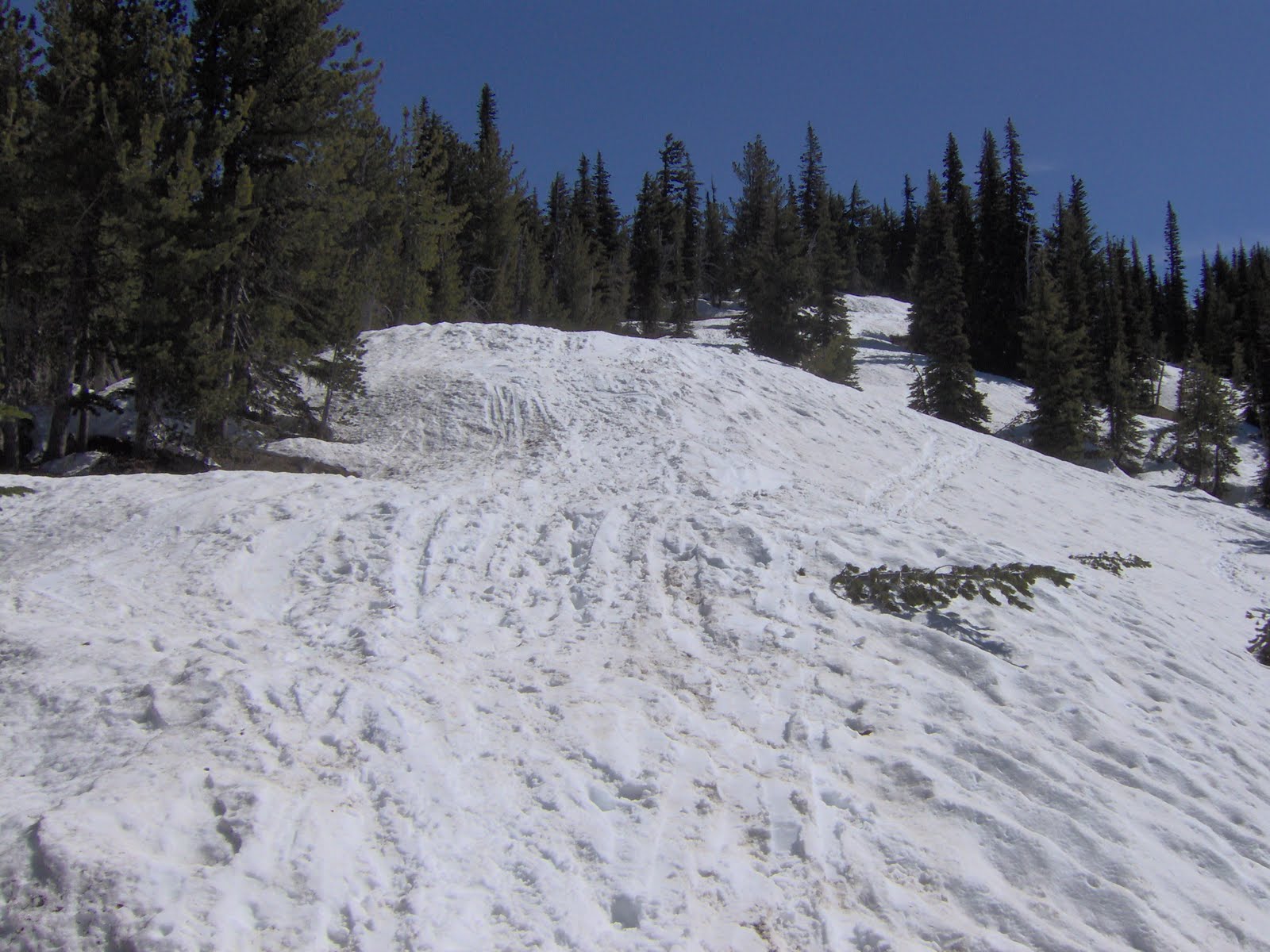
Took off after work to Glenwood, Wa. to my folks place last Sunday with a plan of scouting Mt. Adams on Monday. Not much of a write up, mostly pics and getting familiar with the approach. The road from Morrison Creek to Cold Springs is still snowed in with plenty of blowdown, so an extra 2.25 miles of walking to start the morning. I worked my way up to 7500' and then came back down. I still hadn't fully recovered from the McLoughlin climb the week before. Awesome clear day.






Subscribe to:
Posts (Atom)